
What on Earth Is a Nudibranch? And Why an Ely Art Show Is Celebrating Them

NLAA’s new exhibition, Nudibranchs: The Soft Sculptures of Anna Faye Crockett, celebrates the strange beauty of the ocean and the work of a late Ely artist.

Most people in Ely have probably never heard of a nudibranch.
That may be exactly why this show is worth seeing.
Northern Lakes Arts Association is proud to present Nudibranchs: The Soft Sculptures of Anna Faye Crockett, a special exhibition featuring the imaginative work of the late Ely artist Anna Faye Crockett (1939–2023). At the center of the show are soft sculptures inspired by nudibranchs, brilliantly strange marine animals that look less like sea life and more like something dreamed up by an especially theatrical costume designer.
And once you know what they are, it becomes easy to understand why an artist would fall in love with them.
So, what is a nudibranch?
Nudibranchs are often casually called sea slugs, but that undersells them badly.
They are soft-bodied marine mollusks, close relatives of snails, that have lost their external shells.
Their name comes from words meaning “naked gills,” a reference to the exposed respiratory structures many species carry on their backs. Scientists currently recognize about 3,000 species, and they can be found from the poles to the tropics, in both shallow and deep water.
They are also some of the most visually extravagant creatures in the ocean.
Some look like flowers. Some look like coral. Some look like candy, feathers, flames, or creatures from another planet. They can be neon pink, electric blue, lemon yellow, violet, orange, or combinations that seem almost impossible. There is a reason divers and underwater photographers are obsessed with them.
Why are nudibranchs so incredible?
Because their beauty is not just decorative.
Unlike most snails, nudibranchs do not have a shell to protect them. So they evolved other strategies. Some camouflage themselves so completely they disappear into their surroundings. Others do the opposite: they become vividly, almost absurdly visible.
Those bright colors are often a warning.
For many species, vivid color signals to predators that they are toxic, distasteful, or otherwise a terrible idea to eat. Some species can even synthesize toxic compounds or absorb chemical defenses from the animals they consume.
And then there are the true overachievers.
Some aeolid nudibranchs can steal the stinging cells of the animals they eat, including jellyfish, anemones, and corals. They pass those unfired stinging cells through their digestive system, store them in specialized pouches, and later use them for their own defense. In other words, they turn their prey’s weapons into their own armor.
So yes, they are beautiful.
But they are also bizarre, resourceful, highly specialized, and a little punk rock.
Why Anna Faye Crockett makes perfect sense here
That may be one reason they make such compelling artistic subjects.
Anna Faye Crockett spent her later years in Ely, Minnesota, and while the public record of her artistic life is limited, what remains is memorable. Archival traces connect her to regional gallery exhibition in Kentucky and to national lace circles in the 1980s, suggesting a creative practice shaped by fiber, ornament, handwork, and experimentation.
What this exhibition makes clear is that she had a remarkable eye for form, texture, and delight.
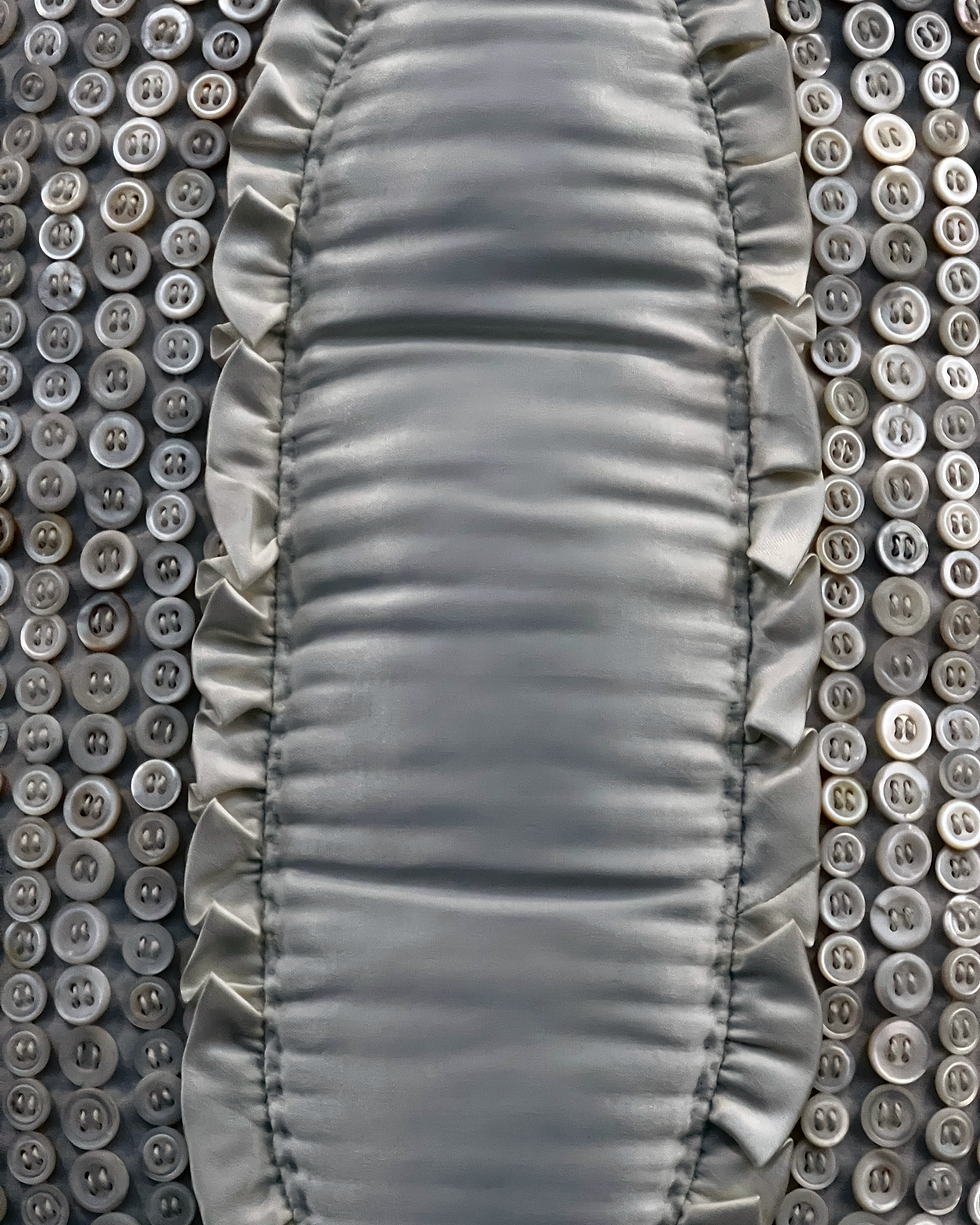
Her soft sculptures inspired by marine life, especially nudibranchs, transform the language of softness, repetition, edge, and movement into something playful, tactile, and unexpectedly elegant.
Nudibranchs are creatures of ruffles, frills, folds, tendrils, and extravagant surfaces. In Crockett’s hands, those same qualities become sculpture.
What might first read as whimsical quickly reveals itself as deeply observant.
These pieces do not simply decorate the idea of sea life. They celebrate its strangeness.
Why this show matters
In a place like Ely, it is easy to think we already know the stories around us.
Then a show like this reminds us how much wonder can still be hiding in plain sight.
Not every artist leaves behind a perfectly cataloged career. Not every meaningful creative life arrives with a full archive, a polished biography, or a museum résumé. Sometimes what survives is more fragile than that.
Sometimes what survives is the work itself.
A handful of objects. A trail of clues. A local memory. A community willing to say: this matters, let’s not lose it.
That is part of what this exhibition is about.
It is about discovery. It is about preservation. It is about the joy of encountering something surprising in your own town. And it is about the role local arts organizations can play in making sure artists, especially artists working quietly and creatively in rural places, are not forgotten simply because the record is incomplete.
What struck me most in inheriting Anna Faye Crockett’s work was how clearly a whole life could be held inside a body of art, and how easily that life could disappear without someone willing to protect it, preserve it, and share it. In a place like Ely, artists often create quietly and deeply, and without institutions willing to hold space for that work, entire lives of art can disappear.
A gift to the community
These works were generously donated to Northern Lakes Arts Association by Firefly Vintage & Goods of Ely, helping preserve and share the art of Anna Faye Crockett with our community. When this collection was offered to NLAA, it became clear very quickly that this was not simply a donation of artworks, but the stewardship of a remarkable artistic life and a body of work worth protecting, preserving, and sharing.
Come see it for yourself
If you have never seen a nudibranch before, this is your chance.
And if you already know what one is, you know exactly why they deserve an art show.
Visit the Exhibition
Nudibranchs: The Soft Sculptures of Anna Faye Crockett is on view at the Ely Area Community Hub and is free to the public during regular operational hours through the end of June.
In a place like Ely, wonder is still hiding in plain sight.
Operating support for Northern Lakes Arts Association is made possible in part by a grant from the Arrowhead Regional Arts Council through an appropriation from the Minnesota State Legislature with money from the state’s general fund.


Thanks for this thoughtful, insightful, and informative commentary. I was familiar with Anna Faye’s lacework and some
of her other creations, but had never seen these pieces before. I look forward to seeing them in person at the hub.
You continue to deepen and enrich the many aspects of NLAA, Ian — our community is very fortunate to have you!